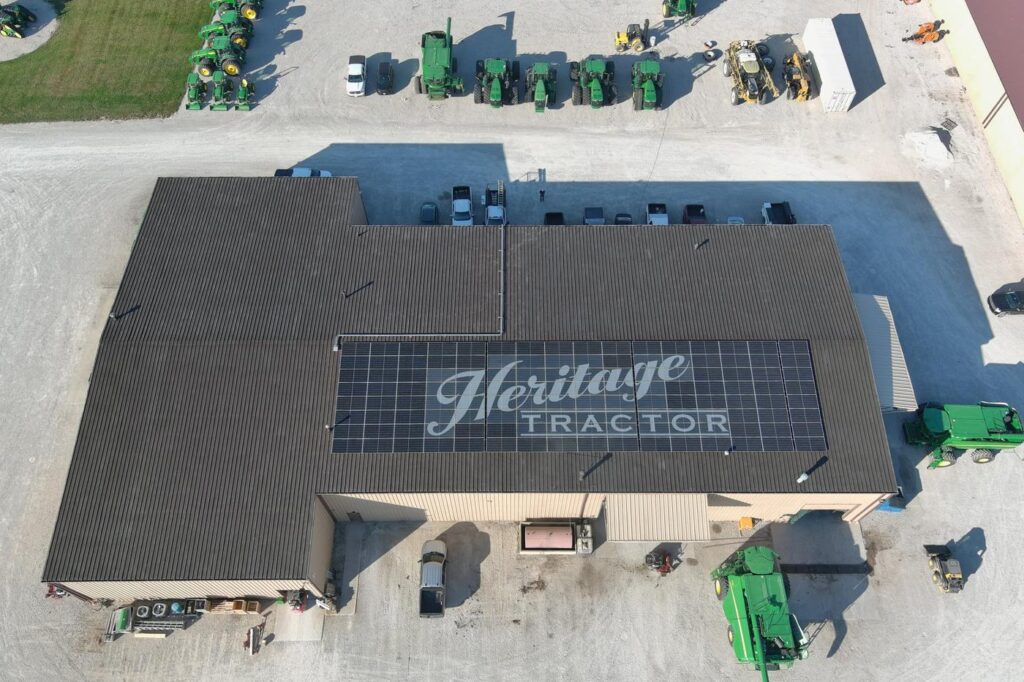
There's no single best panel. For most commercial projects the short list is monocrystalline panels, the most efficient type on the market, from established makers such as Longi, Hanwha Q Cells, Canadian Solar and Trina, compared on efficiency, warranty and, under the 2025 tax law, where they're made. Whichever you pick, SolarSkin can put your logo or colors on them.
Want to see your logo on the panels you're considering? Send it over and we'll mock it up, free.
Quick facts
- Makers with commercial lines worth a look: Longi, Hanwha Q Cells, Canadian Solar and Trina
- The models listed here: 20.1% to 21% module efficiency and 25- to 30-year performance warranties (makers' datasheets)
- Projects that begin construction after 2025 can lose the federal credit over equipment from prohibited foreign entities (The Tax Adviser)
- SolarSkin output by coverage: about 85% full, 92% half, 98 to 99% partial (Sistine Solar)
One of the best places to start is understanding more about solar panel efficiency ratings and what they mean to you. There are several types of solar panels to choose from, and the best one for your business will depend on your specific needs.
How Efficient Are Commercial Solar Panels?
Solar cell technology has experienced significant advancements in recent years, making it an excellent choice for reducing electric bills in residential and commercial applications. The National Renewable Energy Laboratory reports that solar panel efficiency has improved dramatically over the last decade.
The efficiency of solar panels refers to their ability to convert sunlight into usable electricity. It is typically measured by the percentage of the total energy from sunlight the panel can convert. The higher the energy production percentage, the more efficient the panel.
Solar panel power ratings are measured in watts. Standard test conditions (STC) of 25 degrees Celsius and an irradiance level of 1000W/m2 are used. Although these are standard test conditions, real-world circumstances can vary greatly, creating differences in efficiency.
When the outside temperature differs from STC, it increases or decreases power output. This change is known as the power temperature coefficient, and it’s one of the reasons there can be a wide variation in solar panel efficiency depending upon the conditions and installation location.
The average efficiency of a commercial solar panel can also vary depending on the type of panel technology used.
The efficiency ranges for the most efficient solar panels on the market today are as follows:
- Monocrystalline Solar Panels. Monocrystalline silicon panels are the most efficient among commercially available options. Their efficiency can range from about 15% to 22%. Some premium models may achieve efficiencies above this range.
- Polycrystalline Solar Panels. These panels are slightly less efficient than monocrystalline panels, with efficiency typically ranging from 13% to 18%.
- Thin-Film Solar Panels. These are generally less efficient than crystalline silicon panels but can be more cost-effective and versatile. Their efficiency typically ranges from 10% to 12%.
- Bifacial Panels. These panels can capture sunlight from both sides, increasing their overall efficiency. Bifacial panels can achieve efficiencies similar to monocrystalline panels, often in the range of 15% to 20% or more.
When determining which solar energy system is best for you, additional factors should also be considered. Site-specific space, amount of sunlight, upfront cost, tax incentives, and installation requirements can make a significant difference when choosing a solar panel system.
What’s The Difference Between Commercial And Residential Solar Panels?
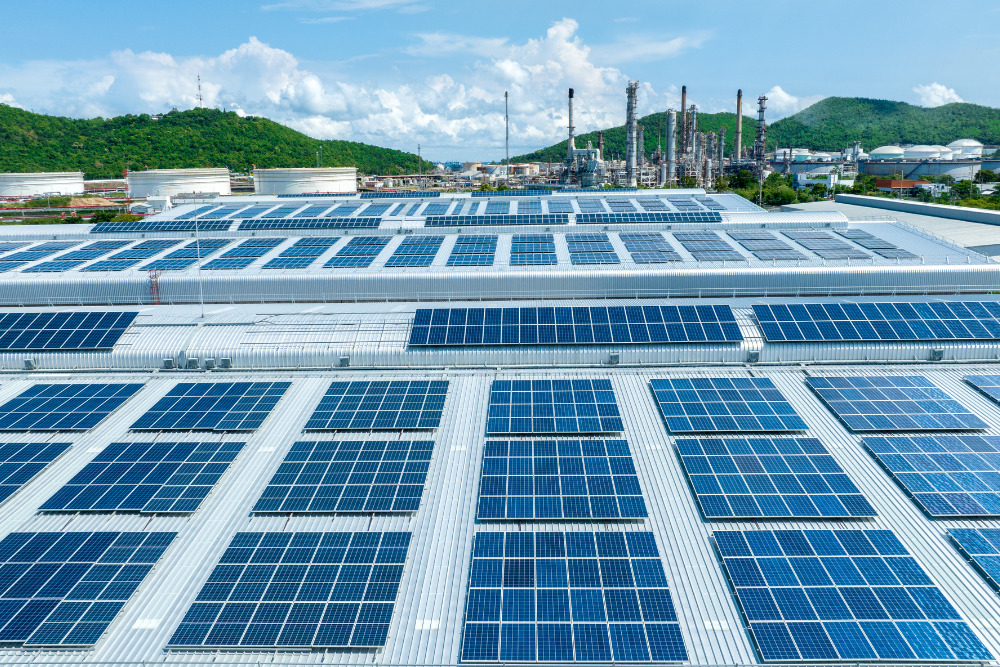
Commercial and residential solar panels utilize the same technology but are designed for different applications.
This means there are some key differences between the two. Among those differences are:
Size and Capacity
Commercial Panels. Commercial solar panels are larger with a higher capacity than residential panels. They are designed to have a higher power output to meet the higher energy demands of commercial buildings, warehouses, factories, and other large-scale applications.
Residential Panels. Residential solar panels are smaller and have a lower capacity than commercial panels. They are designed to cater to the energy needs of individual homes and small-scale installations.
Efficiency
Commercial Panels. Commercial panels often prioritize cost-effectiveness and reliability over achieving the highest efficiency levels. They may have slightly lower efficiency compared to some premium residential panels because a business has a larger installation space.
Residential Panels. Residential panels emphasize achieving higher efficiency, as homeowners often have limited roof space and want to maximize the energy production from their available area.
Design and Aesthetics
Commercial Panels. Commercial solar systems have a more utilitarian design, as functionality and cost-efficiency tend to take precedence.
Residential Panels. Residential solar panel systems offer more design options and aesthetics to blend in with the home's appearance. Some solar panel manufacturers provide sleeker profiles and color options to cater to homeowners’ preferences.
Installation and Mounting
Commercial Panels. Commercial solar panels are typically installed on larger, flat roofs or open areas. Mounting systems for commercial installations need to accommodate higher wind loads and structural considerations due to the panels' size and the installation's scale.
Residential Panels. Solar panel installation in a residence often occurs on sloped roofs. The mounting systems for residential installations are designed to be more adjustable to various roof angles and orientations.
Cost and Financing
Commercial Panels. Commercial solar installations have higher upfront costs due to the higher number of panels and overall system capacity. However, businesses may have access to various tax incentives, grants, and financing options to help offset these costs.
Residential Panels. Residential solar installations are generally smaller in scale and may have relatively lower upfront costs. Homeowners can also use various financial incentives, such as net metering programs (the federal tax credit for home solar ended after 2025), to make the investment more affordable.
Regulations and Permits
Commercial Panels. Commercial solar power system installations require additional permitting and regulatory considerations due to their larger scale and potential impact on local infrastructure and grid systems.
Residential Panels. Residential solar installations also require permits, but the process might be slightly more straightforward due to their smaller size and lower impact.
Overall, while the fundamental technology behind both commercial and residential solar panels is the same, their design, capacity, installation, and considerations differ based on the specific requirements of the application for which they are intended.
Commercial Solar Panel Makers Worth a Look
It’s important to note that what’s considered the “best” commercial solar panels can vary based on your specific needs, such as available space, budget, and efficiency requirements.
There are, however, certain manufacturers that currently dominate the market.
SunPower used to head lists like this one. SunPower Corp. filed for bankruptcy in August 2024, and the SunPower name now belongs to a different company that sells home systems. The four makers below all sell commercial panel lines. The specs are for one commercial model from each; check the current datasheets, since models change every year or two.
Longi
Most popular
Longi produces one of the best and most popular panels on the market. They specialize in high-efficiency monocrystalline panels and have won several industry awards.
- 450w Max Power Output
- 20.7% Photovoltaic Module Efficiency
- 30-Year Performance Warranty
Hanwha
Hanwha Q Cells is a global solar energy company that produces several types of solar panels, including those for commercial use. They are known for their high-quality engineering and solid performance. As a plus, this South Korean manufacturer has invested in American manufacturing, and their panels are made in America.
- 485w Max Power Output
- 21% Photovoltaic Module Efficiency
- 25-Year Performance Warranty
Canadian Solar
Best aesthetics
Canadian Solar is one of the largest solar panel manufacturers in the world. They offer a range of solar panels suitable for commercial applications, often focusing on balancing efficiency, cost, and reliability.
Their Monocrystalline Perc cells also have a sleek design with all-black, anti-reflective glass panels. These panels can absorb more energy than they reflect and generate 30% more energy than competitors.
- 540w Max Power Output
- 21% Module Efficiency
- 25-Year Performance Warranty
Trina Solar
Best all around
Trina Solar is one of the oldest and best-established in the solar industry, with a strong reputation for producing reliable and cost-effective solar panels. They offer a variety of panel options suitable for commercial installations.
Their panels have everything you need in a commercial solar panel: impressive cell efficiency, durability, long lifespan, performance, and a reasonable price point.
- 480w Max Power Output
- 20.1% Module Efficiency
- 25-Year Performance Warranty
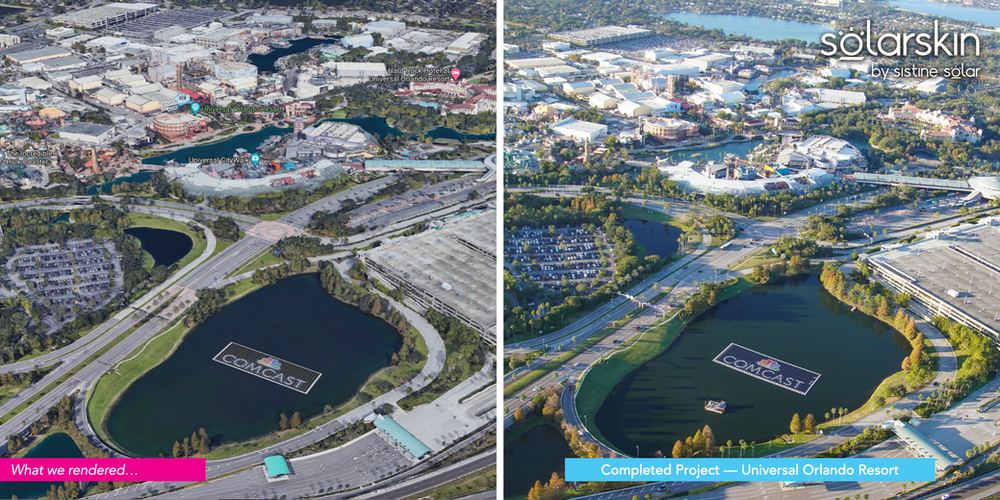
Project: Comcast and NBCUniversal at Universal Orlando Resort. A 250 kW floating array, its design stitched across more than 200 panels: the mockup on the left, the finished array on the right. Read the Comcast story.
Want a mockup like this for your project? Send us your logo and we'll make one, free.
Where the Panels Come From Now Matters
Under the 2025 tax law, a commercial project that begins construction after 2025 can lose the federal solar credit if too much of its equipment comes from "prohibited foreign entities." Ask your installer and your tax advisor how the panels and inverters on your bid count toward that limit, and see our guide to solar tax incentives for businesses for the deadlines.
What’s considered the best solar panels can be debated due to the variability and external influences.
It’s advisable to consult with solar installation professionals, review recent industry reports, and compare specifications and warranties from different manufacturers before deciding. A reputable company will also provide you with a free quote on installation, offer a robust product warranty, and be able to speak to the maintenance and longevity of the system.
What to Watch Out For
- Datasheets change. The specs above are one model per maker, so check the current datasheet for the model on your bid.
- Where the panels and inverters come from can cost a project the federal credit. Ask your installer and tax advisor how your bid counts.
- Planning SolarSkin on those panels? Ask your panel maker before you order. Panel warranties differ on films applied to the glass. SolarSkin's own warranty is on the warranty page.
See your logo on the panels you're considering before you decide. Send it over and we'll send back a mockup.
FAQ
What type of solar panel is most efficient for commercial use?
Monocrystalline. Monocrystalline silicon panels are the most efficient of the commercially available types, which matters most when roof space is tight.
Is SunPower still an option for commercial solar?
SunPower Corp. filed for bankruptcy in August 2024, and the SunPower name now belongs to a different company that sells home systems. For commercial projects, look at makers with current commercial lines.
Does where the panels are made affect the solar tax credit?
It can. A commercial project that begins construction after 2025 can lose the federal credit if too much of its equipment comes from prohibited foreign entities. Ask your installer and tax advisor how your bid counts.
Can SolarSkin go on these panels?
SolarSkin is printed on a film that covers a standard panel, so the installer can use the panels they already specify.
Sources
- Sistine Solar: how SolarSkin works
- NREL: best research-cell efficiencies
- The Tax Adviser, February 2026
- Longi
- Hanwha Q Cells
- Canadian Solar
- Trina Solar
Next reads: SolarSkin FAQ · Solar panel branding · Solar tax incentives for businesses